Future Tokenizer
An IDE for human-AI collaborative thinking

tl;dr
I've never released software before. Three months ago I started building tools in the back of a Lyft, and now one of them is ready for you.
Future Tokenizer is live. Human-curated AI thinking goes in, good plan comes out.
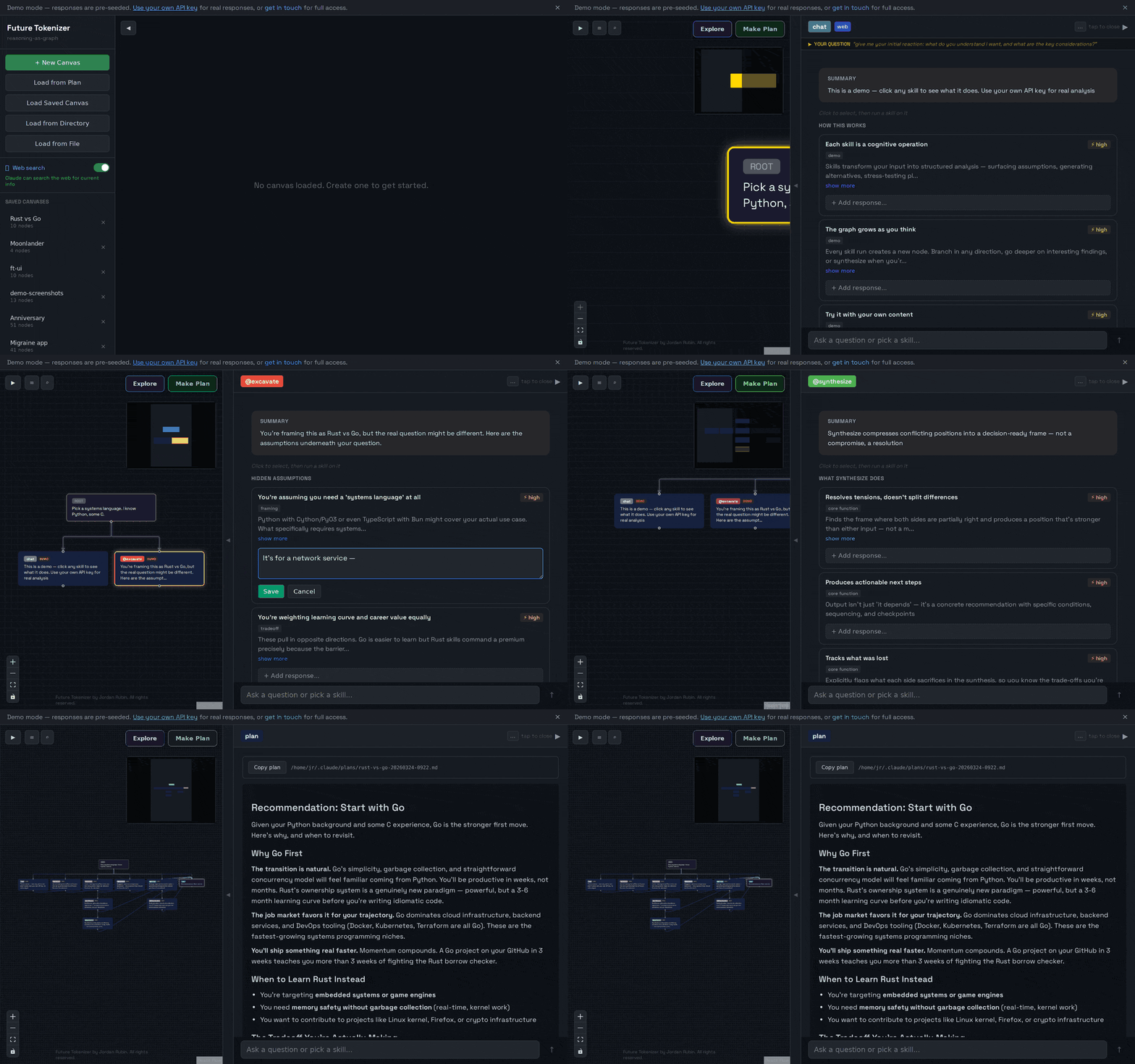
What Did I Do?
Three months ago, I’d never shipped software before. I’ve done quant research and productionized predictive models, sure, but I’d never built something for a person to use.
Since then, working mostly in the backseat of a Lyft during my two-day-a-week commute to my new job at Trexquant, I’ve built:
a controlled experiment comparing AI judges with human experts, accepted to an ICLR 2026 workshop
a custom event tracker iOS app for my wife
a personal website that I think looks pretty nice
a half-dozen other prototypes, most now shelved
All just for fun1. And all built with the tool I’m releasing today.
Future Tokenizer started as my own thinking environment. I dogfooded it, building it while using it to build everything else on this list. Now it’s ready for you.
What Is This?
Most AI chat is a scroll. You type, it responds, context disappears upward. The model always sees the whole chat, but you mostly see the final sentences and the blinking cursor.
Future Tokenizer replaces the scroll with a graph. Every idea is a node, and every node can branch.
You start with a claim or goal: “Future Tokenizer is a graph-based thinking tool.”
You can then run one of the Future Tokens skills on it. Excavate is a good first choice. It surfaces the assumptions that underlie any statement.
Each operation is a card on the graph. Click any card and the right panel shows what it found: in this case, excavate surfacing three layers: hidden assumptions, load-bearing vs. decorative premises, and buried cruxes.
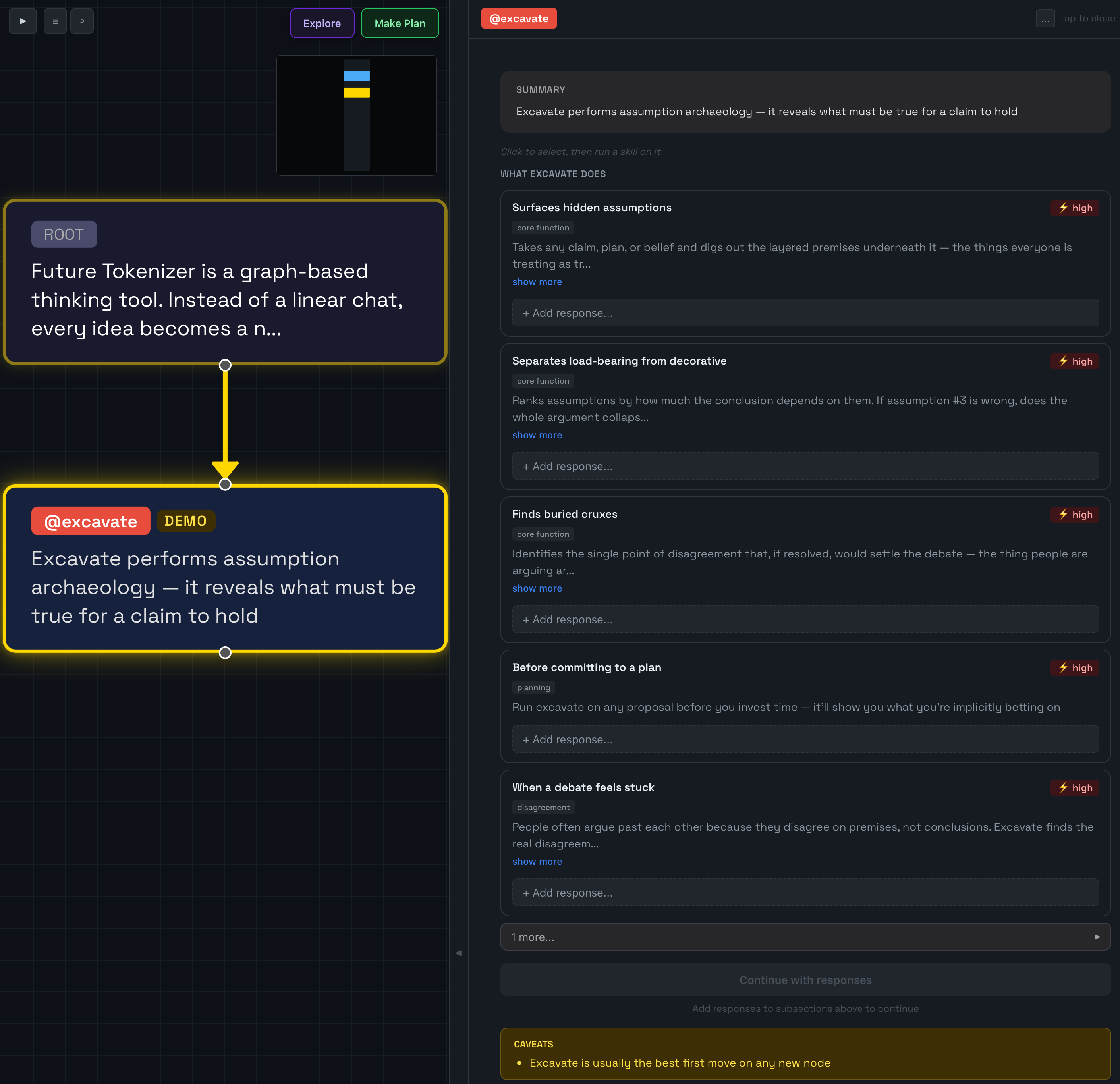
You can continue to run skills or chat turns one-by-one, responding to specific points or not.
Here’s what happens when you press “Explore”:
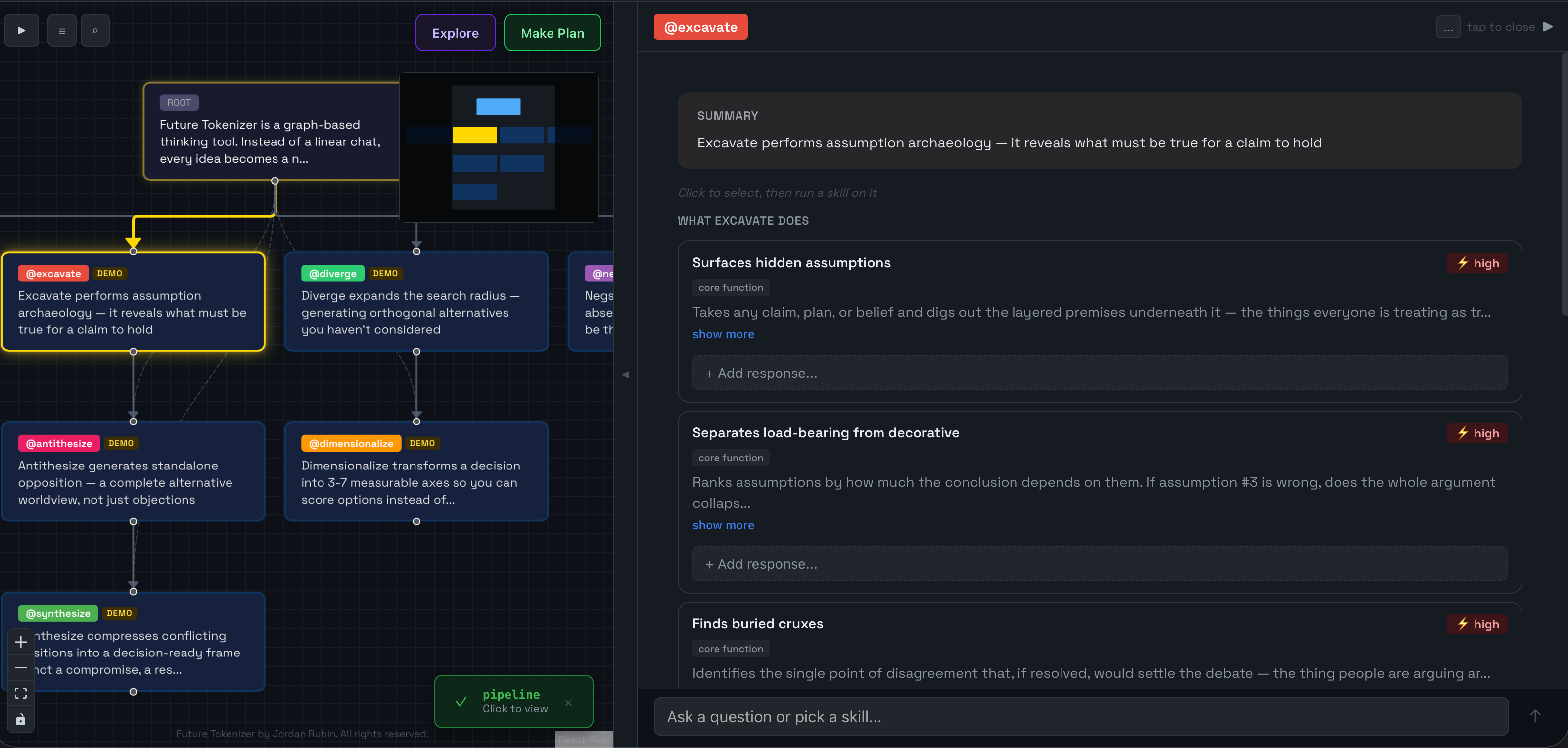
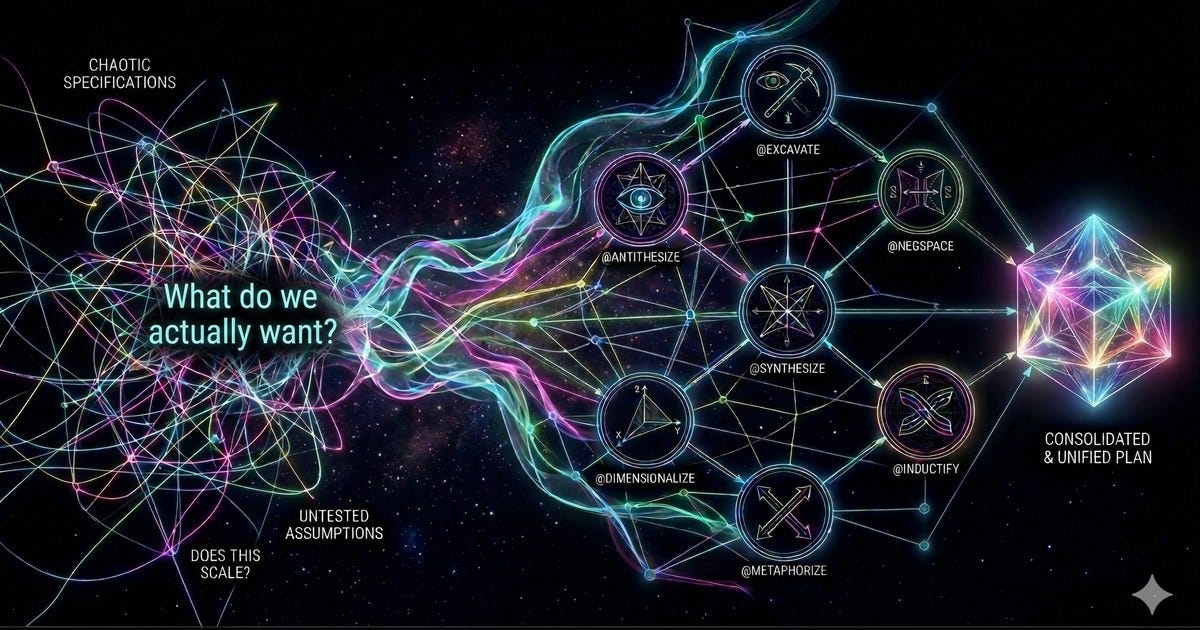
The system automatically runs named thinking operations on your graph, generating many new nodes. Diverge generates orthogonal alternatives you haven’t considered. Negspace finds the argument that should be there but isn’t.
Below that first row, the branches keep going. Antithesize builds the strongest opposing case. Dimensionalize identifies the 3-7 measurable axes that move the system. Synthesize compresses the thread into a decision-ready frame.
Now here’s the full picture once you press “Make Plan”:
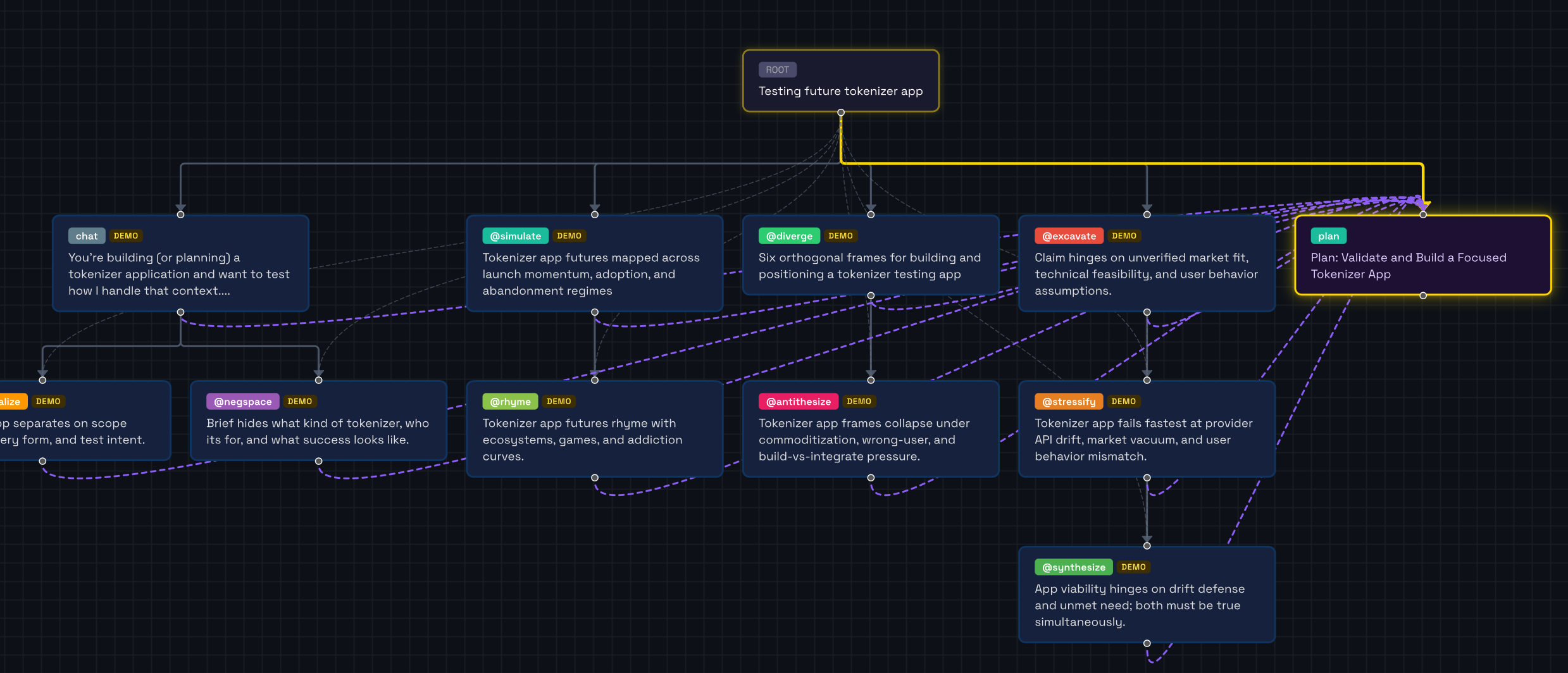
This is one complete run. The root question fans out across five parallel branches: a chat thread, Simulate, Diverge, Excavate, and a Plan node.
Each branch spawns its own second layer. Negspace finds what the chat node missed. Rhyme maps structural parallels to other domains, focusing on the Simulate node’s output. Antithesize builds the case against pursuing the ideas generated in the Diverge node. Stressify hunts for weak points in the assumptions Excavate surfaced.
The threads are all independent, but can be easily combined.
The dashed purple lines show shared context flowing into the yellow “plan” node in the top right, the final output: a compressed, decision-ready handoff; a clean input for Claude code, Cowork, or whatever agent you build with.
Skills are graph operations. The output is a plan you can hand to an agent. Human-curated AI thinking goes in, good plan comes out. Future Tokenizer is an IDE for human-AI collaborative thinking.
Use It If…
…you build with Claude code or similar agents: Future Tokenizer is an upstream tool. It produces the kind of structured, assumption-tested input that makes agent plans not go awry.
…you use AI to solve problems and you’ve noticed that you get samey responses: Future Tokenizer is a way to get new ideas. It runs specific cognitive moves on your ideas and shows you the highlights.
…you ever want to go back to a prior point in a chat and see what would have unfolded if you had responded differently: Future Tokenizer is a way to see alternate paths. Each node shares context with the nodes directly above, but is independent from all nodes across.
My Bet
Thinking has structure: moves, operations, branches, types, tensions, dead ends, convergences. Most interfaces squeeze your thinking into a single textbox that receives a single response. Future Tokenizer expands your response surface, so you can see how many options you actually have.
I don’t think Future Tokenizer is a business. Future Tokenizer is a Claude wrapper. Claude suggests I tell you that “it is a Claude wrapper in the same way that a telescope is a glass wrapper”. But I don’t love the prospects of Claude wrapper revenue models.
The revenue model of SaaS tools is uncertain when a working product can be built in the backseat of a car as one of ten simultaneous projects. But I use this thing every day, and it makes me confident that my plans don’t have Obvious Flaws.
If enough people reason in similar ways, we can build on each other’s practices, and get better at acting in this new world together. I’d love your feedback.
Try It!
Future tokenizer is free to demo. To use it on your own problems, you’ll need an Anthropic API key. Here’s how to get one in 60 seconds. You pay Anthropic, not me. A typical session costs a few cents. The data never leaves your local browser session, so I never see it.
For some reason, agentic development scratches precisely the same itch that turn-based strategy games do
Hi Jordan. I would love to get in touch with you, but your LinkedIn contact email doesn't seem to work? Very interested in discussing your Future Tojken skills ideas in the context of the History domain
Today, Linear announced that they are betting there is a business to build here https://linear.app/next ... might be something?