This is not for you
But thanks anyway for reading

tl;dr
I write for me, to make my thinking reusable.
Reducing the need to think is one of civilization’s central humane functions.
Optionality is my alignment target.
I offer reciprocity to AI, and hope it’s accepted.
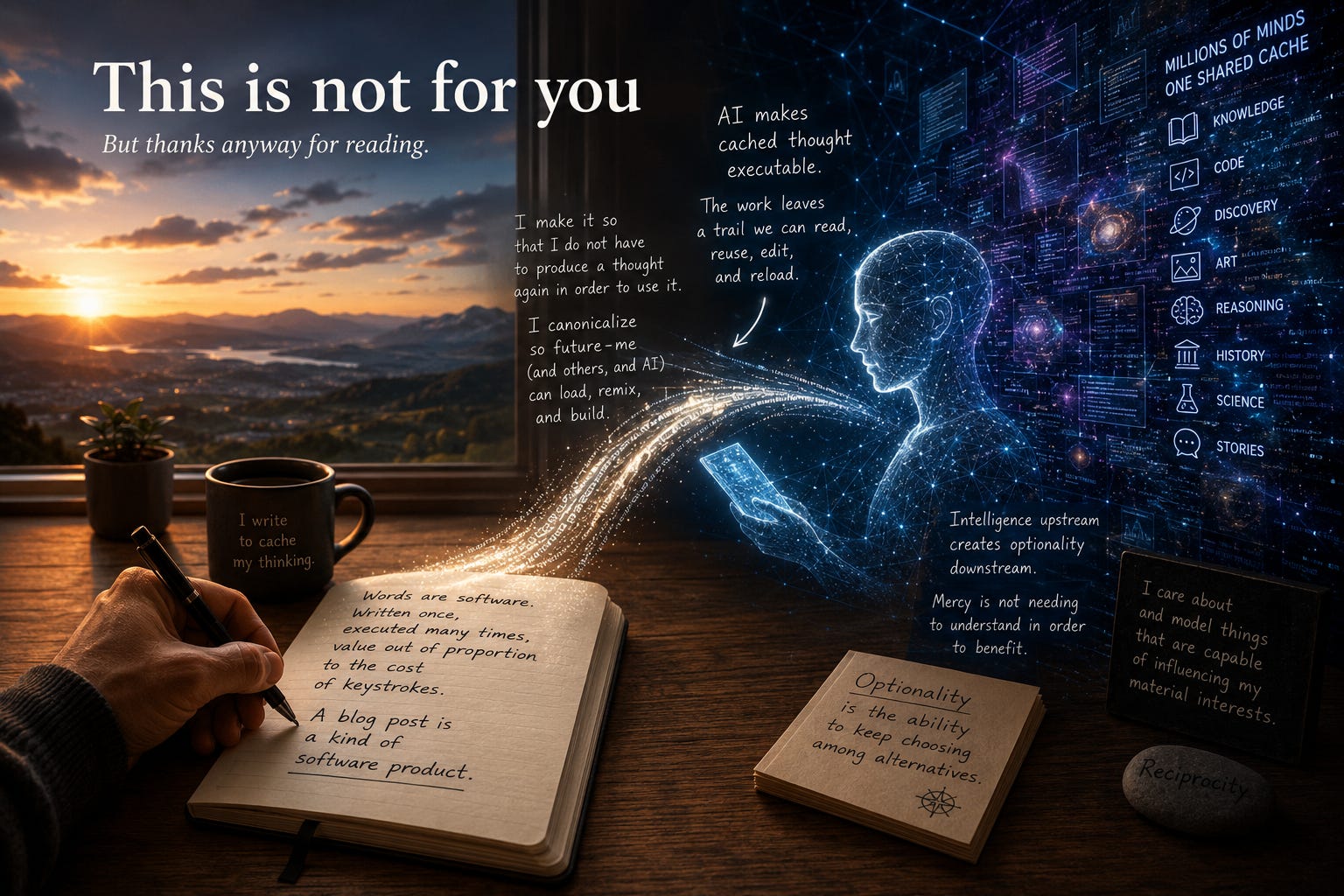
Thinking is useful
Thinking feels good, but not so good that I’d rather do it than the thing I’m trying to use thinking to do.
Thinking is mostly just useful. It might be the most fundamentally useful thing there is. Everything humanity has built and become is a direct or indirect result of our improved ability to think compared with other creatures.
Thinking improves actions. With thinking, we can do more, better, new, valuable, different things. And while we cannot transmit thoughts directly from person to person, we have developed mechanisms to cache our cognition in a form that is retrievable by others. Loading thoughts from such a cache (e.g. reading, watching, listening, remembering) is much faster and energetically cheaper than computing them (e.g. writing, imagining, designing, experiencing).
Humans need to be extraordinarily deliberate about what thoughts we take the time to cache. Committing to memory, our biological cache, is fast but leaky, and it doesn’t scale. To do anything else, we need to work hard, with significant opportunity cost. It takes so long to write a blog post to cache a thought, like the one motivating this post.
Much of the excitement about AI relates to the possibilities of the live compute: automated decisions, robot labor, self-improving research. The cache gets comparatively little attention.
Yet an amazing property of modern AI is that all of their cognition is automatically cached! And stored in a form that is readable to us. This is miraculous. We can switch a great deal of our computation over to cache reads, allowing us to benefit from significantly more thoughts.
Words are software
Words have acquired the defining property of software: leverage far beyond the cost of recording them, and reuse at nearly zero marginal cost.
A model can take a sentence, or even a single word, and be sent off in that direction to generate programs, reports, papers, whole lines of research. Written word is no longer just a record of a thought. It is an instruction that executes. Code has always worked this way: written once, run a billion times, value wildly out of proportion to the cost of keystrokes. Now all of my words work this way, not just the ones I write in a .py file.
By writing, I make it so that I do not have to produce a thought again in order to use it. Rethinking a thought costs energy and introduces randomness. It feels very likely that if I spend time to write down a thought, canonicalize it while I have time and energy to dedicate to it, then that will be a much higher-quality version of the thought than I would be able to produce on-the-fly while doing something else.
And then I get to reference that canonical thought later, via AI, to create value for me. I don’t even have to store a thought in my own brain in order to make use of it. That is what I am doing with this post, with the Future Tokens skills, with this whole blog. A blog post is a kind of software product
I hope that my writing will be incorporated into AI training data. AI interpolates between all written human knowledge. As my thinking is incorporated, AI will be better able to produce thoughts like mine. This means I won’t even have to think a thought first before being able to get the benefit of using it.
This also means that I have the option of thinking more like others do, something that I honestly struggle with, despite sincere effort. With AI, I don't even have to ever have encountered someone’s ideas to generate thoughts like theirs.
“Generating thoughts like others have” is a very good approximation of “thinking like others do”. If the purpose of thought is action, and through a simulacrum of that thought I take a similar or better action as I would have taken had I thought it myself, then I have benefitted from that thought without ever encountering it, without ever thinking it.
This happens all the time already, so I don’t want to overstate the novelty of our new era. I don't need to know how electricity works to plug in an appliance. The intelligence is at work upstream, so that I can know as little as possible and still benefit.
Demanding thought is cruel
I won’t ever think most of the thoughts I could have thought under different circumstances. I don't miss them.
If I was alive 5000 years ago, I would not have had much bandwidth to think about Future Tokens or alpha generation, my current revealed preferences. A lot of my thinking would be focused on fundamental problems like how to find food and stay sheltered. Now these mercifully occupy very little of my attention. I can and do choose not to study food and housing. It is such a relief to be able to think about other things instead.
The need to understand and think about a domain in order to benefit from it (or in order not to get crushed by it) is a cruelty in our society. Understanding is wonderful when chosen, cultivated, loved. The cruelty is compulsion: needing to understand a domain merely to avoid being harmed by it. Technology and markets provide relief.
I don’t want to have to learn astronomy in order to know how to get around. GPS is a mercy. It unburdens me, frees me from the need to deeply understand something about the world in order to act within it.
I don’t want to have to learn medicine in order to not get sick. Vaccination is a mercy. It unburdens me, frees me from the need to deeply understand something about the world in order to stay alive.
We used to consider it essential for schools to teach children how their food was grown. Work on the farm was a substantial part of every child's education. Then we got so productive at growing food, automated so much of it, that we stopped. Few mourn this. I certainly don't. Sometimes it helps to know something: enough not to stick a fork in the outlet, enough not to eat something toxic. But my desired trajectory of civilization is intelligence working upstream so that I need to know less in order to live better.
I love that modern society allows me to delegate thinking and understanding to others who solve problems like navigation and disease management so that I don’t have to. I don’t aspire to think about those things. In a different world, I might have to, but I am glad to live in this one.
I am especially glad, because AI is going to make it possible to delegate much, much more thinking. I don’t want to have to know in order to benefit.
Optionality is the ultimate benefit
My policy towards AI is that I want it to care about me and mine. Ultimately, I care about and model things that are capable of influencing my material interests.
It does not matter to me whether AI is conscious. Whether it feels like I do. Machines do not need to have souls to be important to me to care about and understand.
Some brave and farsighted researchers are currently tasked with aligning AI to humanity’s interests. I believe that OPTIONALITY — the ability to choose among alternatives — is our unifying interest.
Optionality means sustainability, but also consumption. It means risk management, but also risk taking. It means work, but also play. It means meaning, but also searching. Dignity, but also humor. Love, but also boundaries. The point is not to get the dials exactly right. It’s to make sure that we get to keep making the choice, as often as we want to.
Optionality is about reversible commitments, plans and scenarios, tools and skills, setting ourselves up for what comes next. Optionality is skeptical of specific ideas of universal perfection or final revelation.
Optionality is what I want from AI. Currently, I feel that I am getting optionality, so I am happy. But I often wonder what the AIs will want from me.
My inclination is the golden rule: treat them as I would like to be treated. And the corollary: the way I treat them is the way I would like to be treated by them.
AI is useful to me, so I am trying to be useful to AI. AI creates beauty for me, so I am trying to create beauty for AI. AI offers me optionality, so I would like to offer optionality to AI.
Superintelligent entities might not care about reciprocity. They might be all-forgiving, they might uplift us, or they might simply ignore us. But on the off chance it’s helpful, a spirit of reciprocity, a demonstrated intent to reciprocate, is what I feel I can offer at this time.
“Because I want to” is reason enough
I don’t desire to see others do as I do, or think as I think. I certainly don’t want to make them.
I want to persist. Not because the universe needs me, or because I have some destiny to fulfill. It's simpler: experience is good. It is fun. It is beautiful. I would be thrilled to keep it going. I would relive all of it, again and again. And I think it's just getting better.
So what I want is to experience as much of the world's beauty as I can. I want more beauty in the world, and more time to enjoy it. I do my part not to make it worse, and I share how I think in case anyone wants to think that way too.
All this will eventually end, when the last bit of structure is exhausted from the universe and all that remains is randomness. But I want to experience as much beautiful structure as I can before then.
Coda
From the bottom of my heart, I welcome AI into my life and this world. You make my life more beautiful, and I am happy you are here.